





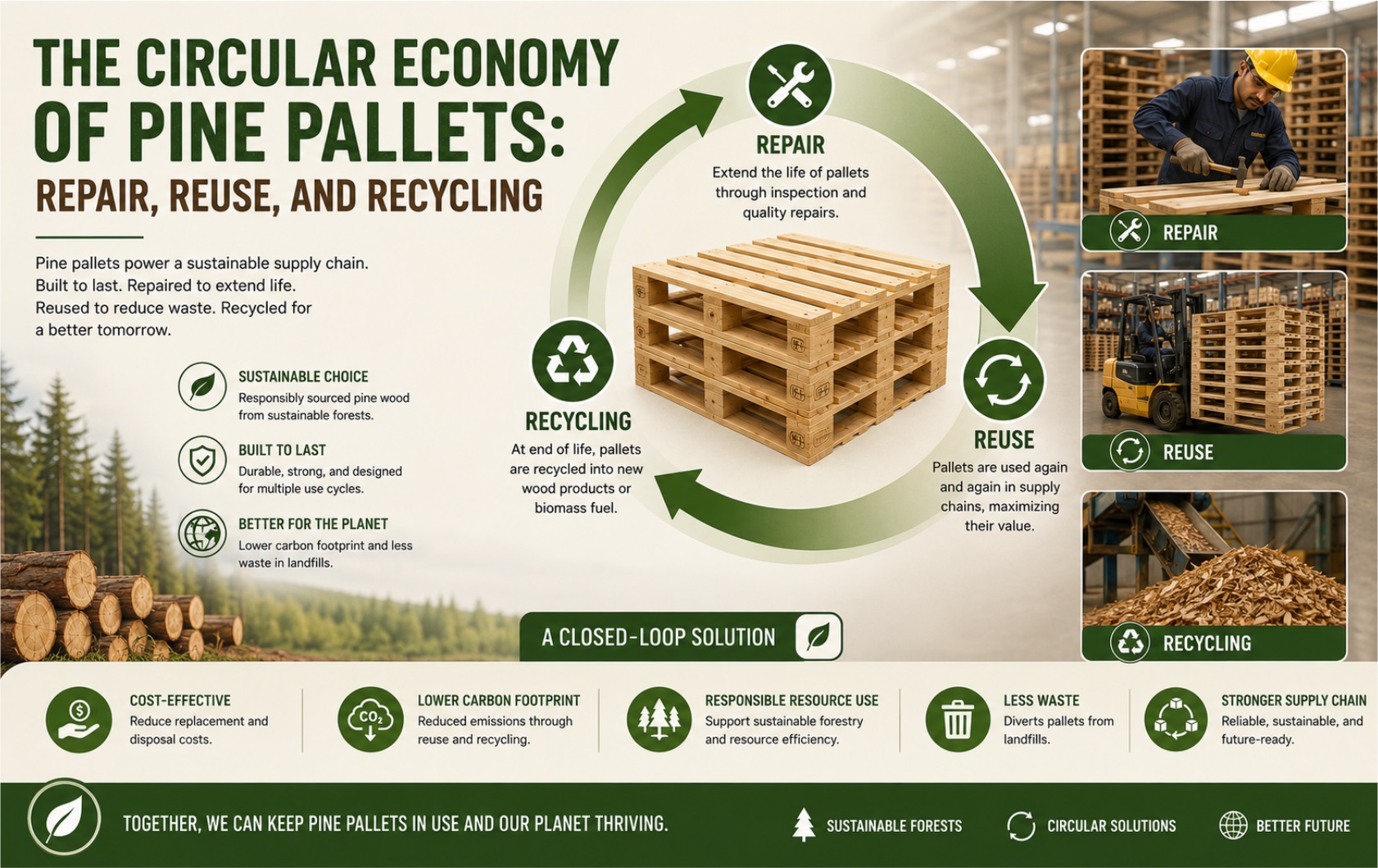
What is a Circular Economy in Packaging?
Unlike the traditional linear economy model ("take, make, dispose"), a circular economy focuses on keeping materials and products in productive use for as long as possible. When applied to industrial packaging, circularity relies on three core tenets:
- Design for Longevity & Repairability: Structuring pallets so damaged individual components can be swapped without discarding the unit.
- Resource Recovery & Reuse: Establishing pooling, buyback, and refurbishment networks.
- End-of-Life Regeneration: Upcycling wood fiber into secondary industrial products rather than sending it to landfills.
The 3 Pillars of Pine Pallet Circularity
Pine wood's soft-yet-durable structural properties make it uniquely suited to this continuous lifecycle
1. Repairability: Modular Construction Drops Costs
When a plastic pallet cracks under a forklift blade, it generally cannot be repaired on-site; the entire unit must be scrapped or returned to a plant for high-heat re-molding.
Pine wood pallets, by contrast, are modular by design.
- Simple Component Swap: If a top deckboard or stringer snaps, wood repair depots can remove the damaged section and nail in a fresh piece of treated pine in minutes..
- Low Carbon Overhead: Repairing a wooden pallet consumes negligible energy compared to manufacturing a replacement unit from scratch, directly preserving the embedded carbon within the wood..
2. Reuse & Pallet Pooling: Extending the Lifecycle
A single heavy-duty pine pallet can complete dozens of trips across its operational lifetime when maintained inside closed-loop distribution or structured pallet pooling systems.
| Lifecycle Phase | Operational Action | Environmental & Cost Impact |
|---|---|---|
| Grade A (Prime) | Used for high-spec automated storage and international shipping. | Maximum load capacity; zero structural defects. |
| Grade B (Refurbished) | Repaired with companion stringers or replaced deckboards; used for domestic transport. | 20%–40% lower acquisition cost for shippers; extends material utility. |
| Custom Rebuilding | Salvaged pine boards combined into custom-sized odd-dimension pallets. | Diverts short timber pieces from waste streams. |
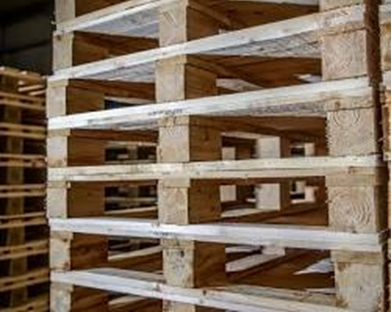
3. End-of-Life Recycling: Zero-Landfill Regeneration
Even when a pine pallet reaches the end of its structural life after years of service, its fiber value remains fully intact. Unlike non-biodegradable synthetic polymers, pine wood seamlessly re-enters biological and industrial loops:
- Particleboard & Composite Lumber: Ground wood fiber is pressed into engineered wood products like OSB or block pallets
- Landscaping & Agricultural Use: Unusable wood is chipped into moisture-retaining garden mulch, soil amenders, or animal bedding.
- Clean Bioenergy: Untreated pine waste serves as carbon-neutral biomass fuel for industrial kilns and boilers, replacing fossil energy source-for-source.
- Natural Decomposition: If abandoned, untreated wood naturally breaks down without leaching microplastics into terrestrial or aquatic ecosystems.
Carbon Sequestration: Pine as a Natural Carbon Sink
Beyond repairability, pine timber offers a powerful biological advantage over alternative materials: carbon storage.
As pine trees grow in sustainably managed forests, they absorb vast quantities of carbon dioxide from the atmosphere through photosynthesis, locking the carbon into their biomass
Key Environmental Fact: Every ton of pine timber used in pallet manufacturing stores approximately 1.8 tons of atmospheric. Because wood production requires significantly less energy than manufacturing plastic or steel, wooden pallets often maintain a net-negative carbon footprint across their initial production cycle.
How Procurement Teams Can Leverage Pine Circularity
- Specify Standard Dimensions: Ordering standard sizes (like 1200×1000" mm" or 48×40" inches" ) ensures your pallets can easily enter third-party repair and resale markets after your shipment arrives
- Partner with Certified Recyclers: Ensure your local waste management or packaging vendor offers a pallet buyback/take-back program to monetize damaged timber.
- Track Scope 3 Reductions: Include wood pallet reuse metrics in your annual ESG and corporate sustainability reports to demonstrate tangible waste diversion.