





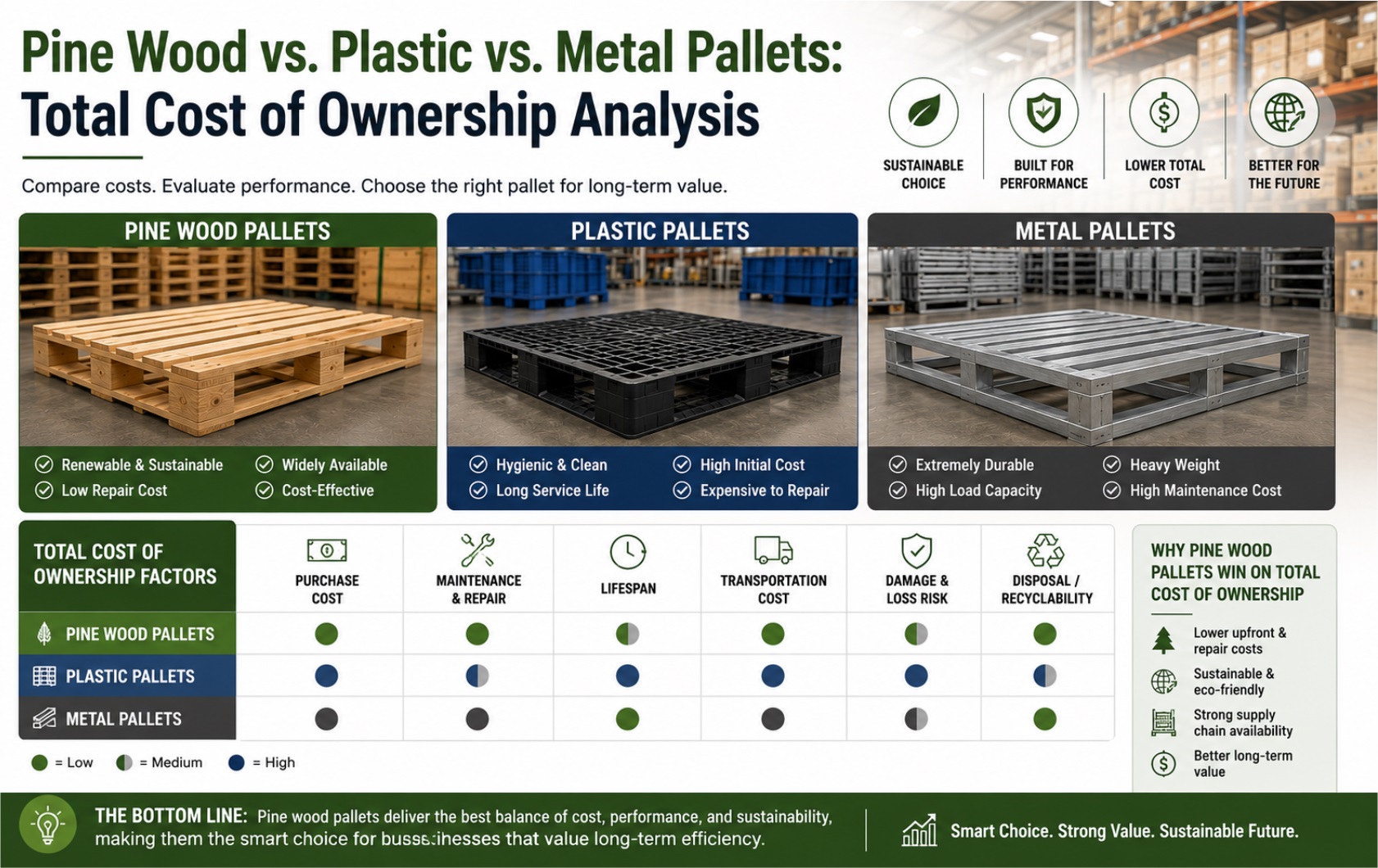
Pine Wood vs. Plastic vs. Metal Pallets: Total Cost of Ownership (TCO) Analysis
When sourcing pallets for industrial supply chains, procurement teams often fall into the trap of evaluating materials strictly by their initial purchase price. However, looking solely at sticker price hides the larger picture.
The true financial impact of your packaging platform is defined by its Total Cost of Ownership (TCO) — a comprehensive metric that factors in initial acquisition, shipping weight surcharges, maintenance, lifecycle durability, custom tooling expenses, and end-of-life residual value.
Whether you are managing closed-loop domestic distribution or one-way international export freight, here is a detailed financial and operational analysis comparing Pine Wood, Plastic, and Metal (Steel/Aluminum) pallets.
What Drives Pallet TCO?
To calculate the true cost per trip, supply chain leaders evaluate five primary cost pillars:
- CapEx / Unit Price: Upfront acquisition cost per pallet.
- Tare Weight & Freight Surcharges: Weight added to cargo (critical for air freight and LTL shipments).
- Lifespan & Maintenance: How many trips the unit survives before repair or replacement.
- Customization & Tooling Costs: Expenses required to adapt dimensions for non-standard equipment.
- End-of-Life Residual Value: Scrap metal value, plastic recycling credits, or wood repair/recycling buyback.
TCO Matrix: Material Comparison
| Metric / Dimension | Pine Wood Pallets | Plastic (HDPE/PP) Pallets | Metal (Steel/Aluminum) Pallets |
|---|---|---|---|
| Initial Purchase Cost | Lowest ($15 – $30) | Moderate to High ($45 – $120+) | Highest ($150 – $350+) |
| Average Lifespan | 5 to 10 trips (repairable) | 30 to 100+ trips (closed-loop) | 100+ trips (heavy industrial) |
| Weight-to-Strength | Excellent (Light & rigid) | Variable (Heavier for high static loads) | Heavy (Steel) / Light (Aluminum) |
| Repairability | Easy & Inexpensive | Difficult to impossible | Requires professional welding |
| Custom Size Flexibility | Immediate (No tooling fee) | Expensive (Requires custom molds) | High (Welded to spec) |
| Export Compliance | Requires ISPM 15 HT Stamp | Exempt | Exempt |
| Primary Use Case | One-way export, general manufacturing, flexible logistics | Closed-loop retail, cleanroom/pharma, grocery | Ultra-heavy machinery, military, automotive |
Detailed Cost Breakdown by Material
1. Pine Wood Pallets: The High-Flexibility Cost Leader
Pine wood continues to dominate global shipping (accounting for roughly 80% of the pallet market) because of its exceptional balance between weight, structural strength, and affordability.
- Upfront Acquisition: Pine wood is significantly cheaper upfront than plastic or metal, preserving working capital for large-scale logistics operations.
- Freight Efficiency: Softwoods like Southern Yellow Pine offer a high strength-to-weight ratio. They are lighter than many heavy-duty plastic or steel alternatives, keeping container and truckload tare weights low.
- Low-Cost Maintenance: When a pine deckboard or stringer snaps, it can be replaced in minutes using standard tools for a fraction of a dollar
- Zero-Tooling Customization: Unlike plastic molding, custom pine pallets do not require expensive upfront tooling or die costs. Dimensions can be altered on demand to optimize sea container footprint and eliminate dead space.
- TCO Verdict: Best for one-way export shipping, varying cargo dimensions, and supply chains where pallet retrieval is unfeasible or expensive
2. Plastic Pallets: The Hygienic Closed-Loop Contender
Plastic pallets (typically high-density polyethylene or polypropylene) shine in automated facilities and tightly controlled internal distribution networks
- High Initial Investment: Plastic pallets require 3x to 5x the initial capital outlay of pine wood pallets.
- Long Closed-Loop Lifespan: In a 100% controlled, closed-loop network (where pallets return to the starting warehouse), plastic units offer a high trip count, gradually offsetting their higher upfront purchase price.
- Sanitation Strengths: Plastic is non-porous and washable, making it ideal for pharmaceutical cleanrooms and direct food contact applications.
- TCO Risk Factors: In open supply chains, a lost or unreturned plastic pallet represents a major financial loss. Additionally, cracked plastic deckplates usually cannot be repaired and must be recycled entirely.
3. Metal Pallets: The Heavy-Duty Niche Solution
Constructed from carbon steel or aluminum, metal pallets are designed for extreme environments, heavy static loads, and specialized industrial manufacturing.
- Highest CapEx: At $150 to $350+ per unit, metal requires substantial capital commitment.
- Extreme Durability: Metal resists extreme temperatures, radiation, and heavy impacts, surviving decades in closed internal manufacturing loops.
- Weight Overhead: Carbon steel pallets add significant tare weight, increasing fuel and freight costs for long-distance transport. Aluminum provides a lightweight alternative but comes at a premium purchase price.
- TCO Verdict: Economical only for specialized heavy manufacturing, chemical storage, or closed internal loops with zero loss rates.
Key Takeaways for Logistics Managers
Rule of Thumb: If your packaging leaves your facility and never returns (one-way export or open distribution), Pine Wood yields the lowest Total Cost of Ownership by a wide margin.
- For One-Way Export Freight : Pine wood is the clear winner. The high risk of lost pallets in international waters makes high-CapEx plastic or metal cost-prohibitive.
- For Closed-Loop Internal Systems : Pine wood offers immediate custom engineering without the thousands of dollars required for plastic injection molds.
- For Closed-Loop Internal Systems : Plastic or metal pallets become financially viable only when you maintain a near-100% pallet retrieval rate over dozens of trips.